Yvonne Arlott Woodturning Artist

FAQ about Woodturning Techniques

I have now been a woodturner for eight years and over that time through reading books, watching videos and DVDs and trial and error I have learnt a variety of woodturning techniques. I have also developed my own methods and tried to create new and interesting art forms in the wonderful medium of wood.

Below are the most common questions I get asked about the woodturning techniques I use.
"How do you do the lacework effect on the rims of lacework bowls and platters?"

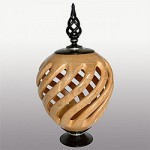
Blue Star Bowl

Initially I turn the rim of the bowl reasonably thinly and evenly before using a Dremel type carving tool to carve each individual hole. It takes me a long time since I have to be careful when carving to try to ensure that the holes are spaced evenly and also that I don't end up with some very big holes and other tiny holes which wouldn't give the same effect. Finally I hand sand each hole in turn.

There are several tools available that can be used for the carving but they mainly fall into two types air-powered drills and mains powered drills.

When I do lacework bowls the random pattern of holes I carve are all done by eye but when I create the more elaborate and complex designs such as the tallship on the platter or the seahorses on the Sea Life Vase I mark the designs out first. I also often enhance the carving by burning parts of the design with a pyrography kit.

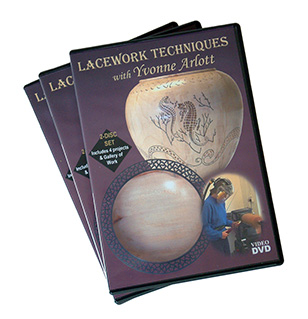
I have now released a woodturning DVD on this particular subject, called Lacework Techniques with Yvonne Arlott, which covers it in more detail including the turning and carving of the Sea Life Vase.


"How do you make an Open barley twist vase and is carving involved?"

Basically a barley twist vase is a hollow form that has been turned with an even wall thickness and then the binds carved into it afterwards.
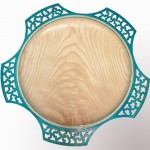
I firstly use chisels and a lathe to turn a vase or hollow form, depending on the design, from a log of wood. The inside of the vase is turned away through the hole in the top whilst the rest of the form is left as solid wood. Once I've turned the vase I use the indexing ring on the lathe to mark out where I want the binds and also the shape of the binds before using carving tools to carve the wood away in between each bind.

I find it is easiest to mark out the position and curvature of the binds in pencil first before carving since it can be a little tricky working out the optimum shape of the binds that best suits the overall shape of the vase and gives the most ascetically pleasing form.

Once I'm satisfied with the carved binds I then hand sand each one and finish the vase.

Terms of Use | Privacy Policy | Site Map
Art In The Woods
Copyright © 2004 Yvonne Arlott. All rights reserved.
Website by TOLRA Micro Systems Limited